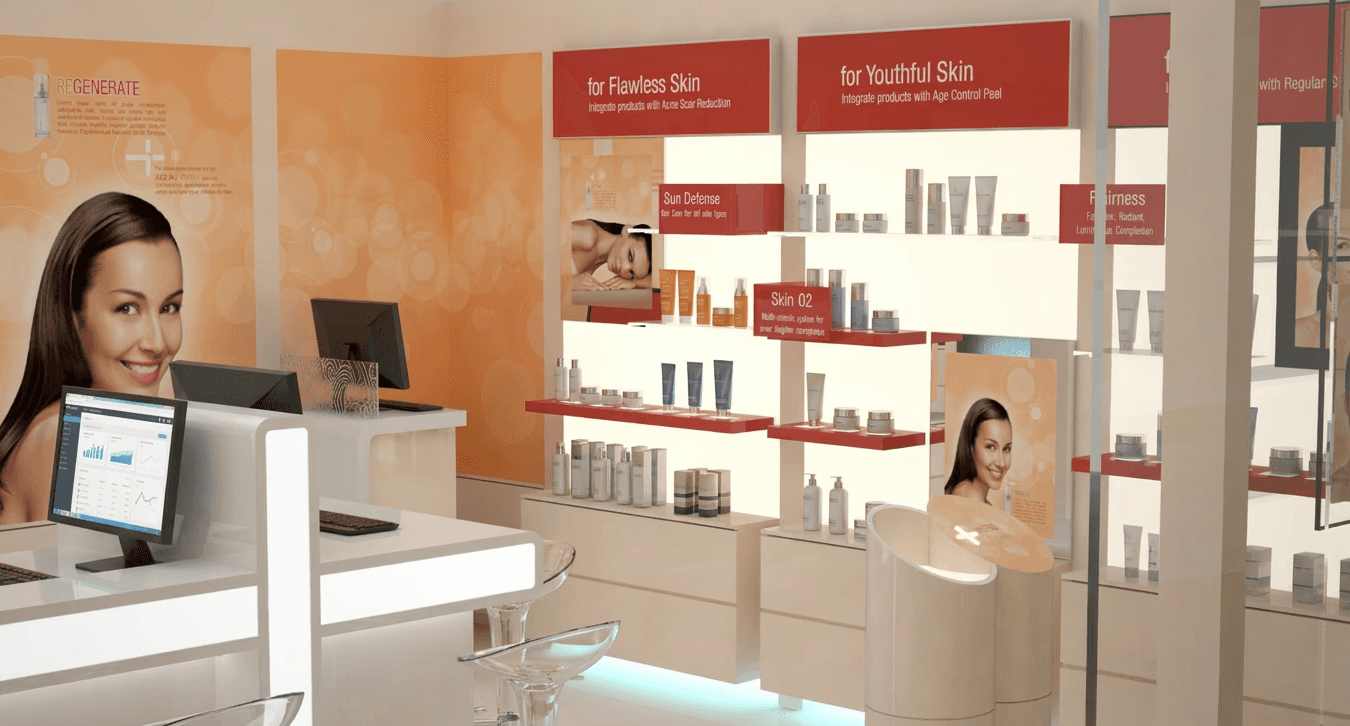
Walk into most retail head offices and ask how a store is performing, and you'll get the same answer everywhere: footfall-to-conversion. How many people walked in, and what share of them bought something. It's a clean number, it's comparable across stores and seasons. It has become the industry's default scorecard for long enough that almost nobody argues with it anymore.
The argument worth having is whether brands are measuring the right thing by tracking conversion and if that single ratio can carry the same meaning in every category it's applied to.
A ratio built for one kind of store
Footfall-to-conversion answers a specific question well: of the people who walked in today, how many bought something today, in this building. That's a fair test for a category where the purchase decision genuinely gets made inside the store, furniture you need to sit on, a mattress you need to lie on, a suit that needs to be measured against a body, jewellery someone wants to see catch the light before committing. In those categories, the store isn't one option among several channels. It's where the decision actually happens and a low conversion rate there is a real signal that something in the space, the staffing or the assortment isn't working.
The ratio gets less useful the moment a category doesn't require that kind of in-person resolution. A shopper who walks into a well-known apparel brand's flagship, tries nothing on, buys nothing that day, and orders the same jacket from the app that night has just delivered the brand a sale. The footfall-to-conversion number for that store, that day, records it as a miss.
What the store was actually doing that day
The retail industry has its own name for this gap, and its own data on how large it is. ICSC, the trade body for shopping centres, has spent several years measuring what it calls the "halo effect." It is the lift in online sales that follows the opening of a nearby physical store. Its most recent analysis, covering nearly $850 billion in card transactions across 69 retailers and more than 2,100 stores, found that opening a store lifted online sales in the surrounding trade area by an average of 6.9 percent in the following weeks, rising to 11.6 percent for apparel brands, 13.9 percent for digitally native brands opening their first physical locations and as high as 50.6 percent for department stores. Closing a store did the reverse: online sales in that trade area fell by an average of 11.5 percent, with the sharpest drops concentrated in discretionary categories like home and department stores, where in-person browsing appears to matter most.
A related study from the same research series found that shoppers who spent $100 in a store and then bought online from the same retailer within fifteen days went on to spend $267 in total. The reverse held too, at a slightly lower figure: shoppers who spent $100 online and then bought in-store within the same window went on to spend $231 in total. Either direction, the number is well above the $100 that a channel-by-channel report would show.
None of that shows up in a footfall-to-conversion report. It shows up in a different retailer's dashboard, in a different week, attributed (if it's attributed at all) to marketing or to the website, rather than to the store that actually created the impression.
Two different jobs, one ratio
This is really a story about two categories of retail wearing the same scorecard.
In the first category, anything where touch, fit or trial is part of how the decision gets made; the store's job and the conversion event happen in the same place at the same time. A made-to-measure suit brand like Indochino, which built its business online and later added dozens of showrooms, still needs a customer to feel the fabric and get measured before the purchase makes sense. For that category, footfall-to-conversion is close to a complete measure, because there's nowhere else for the value to leak out to.
In the second category, commodity goods, trust-established brands, anything a customer is comfortable buying without inspecting it first; the store's job has quietly shifted from closing the sale to building the impression that closes it somewhere else. A flagship in this category is doing real commercial work even on a day when nobody at the till rings up a sale, and a footfall-to-conversion number that doesn't distinguish between these two categories will consistently make the second kind of store look like it's underperforming, when it may simply be doing a different job well.
Why the store creates that lift in the first place
There's a reasonably specific explanation for why a short visit to a physical space produces value that shows up somewhere else entirely, days later.
There's research suggesting two separate reasons a physical visit encodes more strongly than a digital one. Aradhna Krishna's work on product scent found that a scent cue attached to a product measurably improved recall of that product's other attributes, with the effect still detectable two weeks later. It serves as an evidence that a single well-placed sensory input can lengthen how long something stays in memory. Separately, Krishna's research on multisensory advertising found that ads engaging more than one sense produced a stronger positive impression than single-sense ads, but that this advantage was significantly weakened when researchers gave people's attention a second thing to do at the same time. Put the two findings together, even loosely and they point in the same direction: sensory richness helps memory and divided attention undercuts that help. A screen, almost by definition is asking for divided attention, a tab, a notification, a second app open underneath the first. A physical store, for the length of a visit, generally isn't competing with anything else for a customer's senses.
Something similar shows up in the older marketing research on "servicescapes," which is the physical layout, lighting and atmosphere that Mary Jo Bitner argued, in a 1992 Journal of Marketing paper, actively shape how customers think and feel rather than serving as passive backdrop. Later research linking servicescapes to hotel guest loyalty explains part of that link through "place attachment," an emotional bond made up of place identity and place dependence tied to a specific location. That research does treat returning to the same property as one sign of loyalty, alongside recommending it to others. The two are usually measured together, not as substitutes. But for a brand operating across several locations and channels, the more useful reading isn't the location-specific finding itself; it's the underlying mechanism. If a strong emotional bond to one hotel property predicts a guest returning to it, there's little reason to think that bond stops mattering the moment the same brand is chosen through an app instead of a lobby. The attachment research was built to explain revisits to one address. Extended to a multi-channel brand, the more plausible reading is that the same bond can resurface as a choice made anywhere.
What a better metric would need to do
None of this means footfall-to-conversion should be abandoned. For the categories where it was built, which are primarily trial-dependent and decision-in-the-room categories, it remains close to a complete picture. The gap is in applying it uniformly to categories where the store's real contribution is upstream of the transaction rather than inside it.
A more complete scorecard for those categories would need to sit alongside footfall-to-conversion, without replacing it: online sales lift in the store's trade area following opening or renovation, the conversion-rate difference between customers who have and haven't visited a physical location, and basket-size change in the weeks after a store visit, echoing the pattern ICSC's research already tracks industry-wide. None of these numbers are exotic, most retailers already have the loyalty-ID and transaction data needed to build them. What's missing, in most organisations, is a decision about which category a given store belongs to before choosing which ratio gets to define whether it's succeeding.
The point of the room
A store in a trial-dependent category and a flagship for a well-trusted, low-touch brand can look identical on a footfall-to-conversion report and be doing entirely different jobs. One is closing a sale. The other is manufacturing a memory that closes a sale somewhere else, later, on a channel that will get the credit for it.
The mistake is assuming that every physical space converts in the same place it happens to be standing.