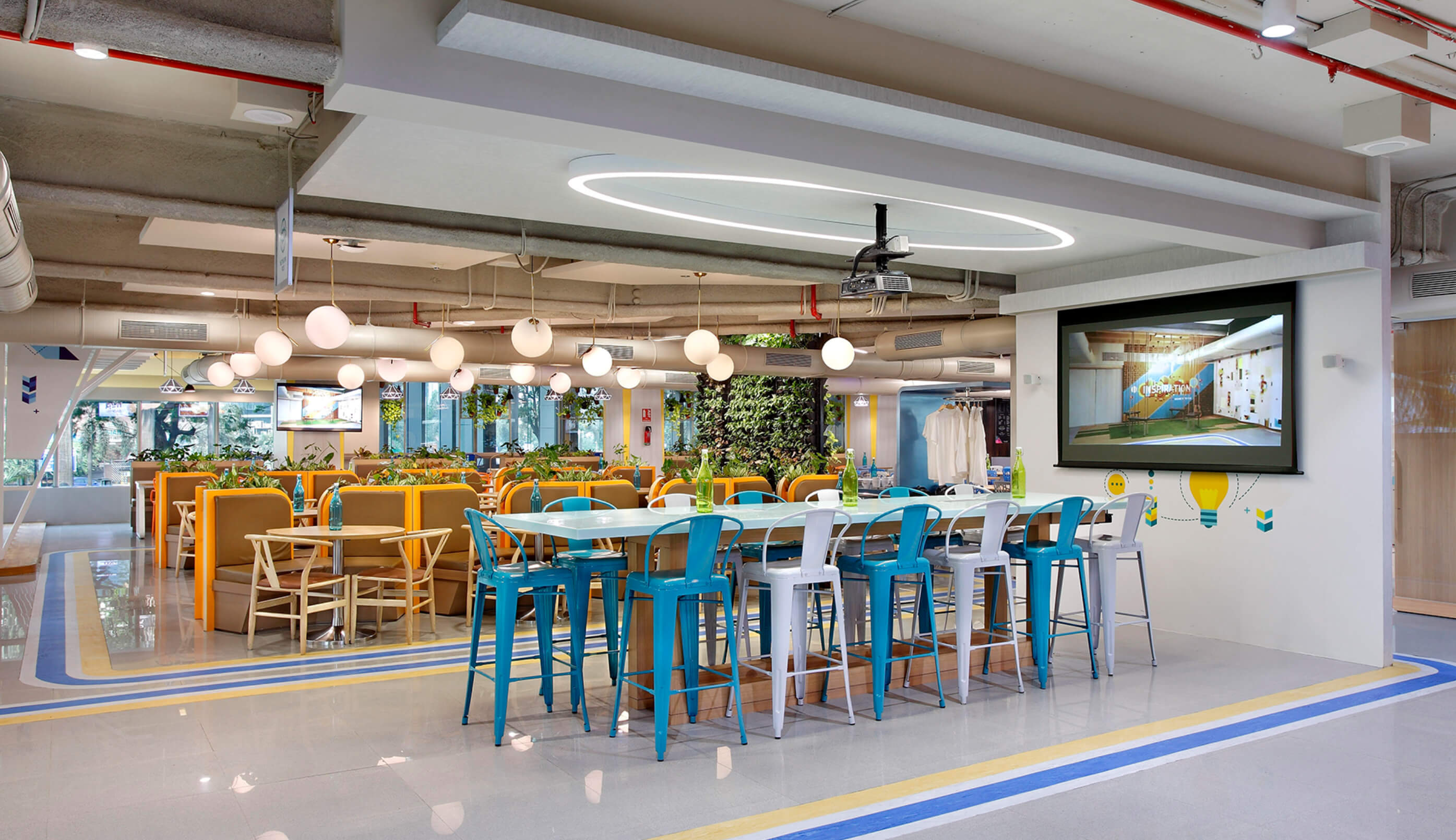
The cafeteria at ICICI Bank's headquarters served nearly three thousand employees a day. It did its job. People collected trays, ate lunch, checked their phones, and returned to their desks. The room was functional in the way that most corporate amenities are functional: invisibly, adequately, forgettably. Then, a few years ago, the bank called in a design firm to renovate it. The brief, as far as the bank was concerned, was straightforward: make it better. What happened next is a more interesting story. The design firm looked at the space, looked at the organization, and came back with a different question entirely: what if this room could become the cultural heart of one of India's largest financial institutions?
What emerged (now called the Centre of New) is neither cafeteria nor office nor showroom, but something in between. It is a space that feeds people at noon and hosts yoga at seven in the morning and functions as a town hall for a thousand employees on a Tuesday afternoon and serves as a live testing laboratory for digital products that haven't yet gone to market. It is, above all, a declaration: that this institution knows what it believes, and is willing to put it in the floor plan.
This story is about what is happening to the office and, more broadly, to all physical space in an era when the business case for buildings has had to be made again from scratch.
The Office Has Lost Its Function
For most of the twentieth century, the office existed because work required proximity. Files were physical. Typewriters were heavy. Information lived in rooms, not clouds, and accessing it meant going somewhere. The office was an infrastructure.
That infrastructure began to erode long before the pandemic accelerated its collapse. Laptops made workers mobile. Email made synchrony optional. Cloud storage dissolved the file room. By the time a global health crisis forced entire workforces home in 2020, the experiment that resulted confirmed what many had suspected: most knowledge work could be done, quite effectively, from a kitchen table.
What this created was not the death of the office but its identity crisis. If the office is no longer the place where work happens, then what is it? A social venue? A branding statement? A monument to organizational ambition? An expensive holdover that the C-suite is emotionally attached to?
The most interesting answer is also the most demanding one: the office, in its new form, must justify itself not through function but through feeling. It must be a space that people choose to inhabit that generates something they cannot get from their kitchen tables or from a video call.
It must, in other words, produce an experience worth having.
The Emergence of a New Spatial Type
The experience center did not begin in corporate real estate. It began, as most design ideas do, at the edges of the economy in luxury retail, in cultural institutions, in the world's great museums and their gift shops. The logic was always the same: beyond utility, beyond transaction, there is a category of spatial encounter that produces belief. You leave not just informed or satisfied, but changed.
What is new is the speed at which this spatial logic has migrated into sectors that once considered themselves exempt from it. Banks, technology companies, and financial institutions, organizations whose product is, at its core, a promise, have discovered that the era of explaining themselves is over. Their employees, partners, and customers have grown up in environments designed by the world's best design teams, environments in which every interaction has been engineered for maximum resonance. The spreadsheet, the PowerPoint, the guided tour in a room that smells of carpet cleaner: none of this competes.
What competes, it turns out, is space. Deliberately designed, rigorously intentioned, narratively coherent space. The experience center as a hybrid of showroom, cultural environment, and strategic communication tool is emerging as one of the defining spatial typologies of this decade. And the institutions building them are not the most flamboyant ones. They are the ones that have thought hardest about what they need their people and their visitors to believe.
It Begins with Intent
The single most reliable predictor of whether an experience hub will succeed is whether the people who commissioned it could answer one question before the first design meeting: What do we need this space to do?
Not in the abstract. Not "inspire employees" or "reflect our values." Specifically. Is this space for recruitment, for retention, for investor relations, for cultural expression, for product testing, for a combination of these things and if so, in what priority order? The answer determines everything: the spatial sequence, the content decisions, the technology choices, the human experience layer. Without it, the project becomes a beautiful room that nobody quite knows how to use.
What makes the ICICI story instructive is that the intent that arrived with the brief was a renovation problem. They had a cafeteria and they wanted it improved. The ambition to turn 10,000 square feet of dining facility into a multifunctional cultural hub that would support collaboration, express organizational identity, enable digital product testing and serve employees from the first yoga session of the morning to the last town hall of the afternoon was a proposition EuMo brought to the table.
This is a more common dynamic than institutions like to admit. Organizations often sense that their spaces are underperforming without being able to articulate exactly what they should be doing instead. The gap between "make it nicer" and "make it matter" is precisely where design intelligence operates. EuMo's value in the ICICI engagement was not primarily aesthetic. It was diagnostic: identifying what the space could become, building the case for it, and then designing the environment to deliver on that elevated brief.
Intent, in other words, is not always the client's to supply. Sometimes it is the designer's to discover and to convince.
Understanding Is Sequenced
There is a profound difference between the way a website communicates and the way a physical space does. A website can be entered from any page, navigated in any order, abandoned at any moment. It is, by nature, non-linear and forgiving. A physical space unfolds in time. You move through it. The sequence in which you encounter its elements shapes what you make of each one and, ultimately, what you believe about the whole.
This sequencing is not decorative. It is epistemological. In the ICICI Centre of New, the decision to begin the spatial experience with social and communal zones before arriving at collaborative work areas establishes a register; this is a human space first, a work and lunch space second. This conditions how everything encountered afterward is interpreted. A collaborative meeting alcove encountered before any sense of social warmth reads as a corporate amenity. Encountered afterward, it reads as an extension of community.
The designers who understand this are the ones who think about experience hubs the way a novelist thinks about chapter order, or the way a filmmaker thinks about scene sequence. The content matters, but the arrangement of content is what produces meaning.
Narrative as Compression
Walk into any large organization's headquarters and you will confront the same communication problem: there is too much to say. Too many products, too many values, too many achievements, too many years of history, too many people whose contributions deserve acknowledgment. The impulse is to present all of it and the result, almost invariably, is that none of it lands.
Narrative is the technology for solving this problem. Not a list of facts with connecting tissue, but an argument with a protagonist and a through-line. The Centre of New's narrative is not, at its core, about ICICI Bank's balance sheet or product portfolio. It is about the kind of organization that a young, ambitious employee might want to be part of, what it feels like to work somewhere that is genuinely building the future, rather than administering the past. The bank's digital capabilities, its innovation culture, its commitment to inclusion: all of these become evidence in service of that central claim.
When narrative is built correctly, the visitor or employee does not experience the space as a presentation. They experience it as a confirmation of something they already suspected and that confirmation is among the most powerful forces in human psychology. It produces loyalty, advocacy, and the particular kind of commitment that no performance review can manufacture.
The Choice of Medium
Every element in a thoughtfully designed environment carries cognitive weight and different media carry different kinds of weight. Physical materials (wood, concrete, textile, light etc) speak to the body before they speak to the mind. They establish warmth or austerity, permanence or flux, intimacy or scale. Digital elements such as screens, interactive surfaces, projection, speak more directly to the intellect. They carry information efficiently but are also, by familiarity, easier to dismiss.
The craft in experience design is knowing which medium to use for which message. The Centre of New integrated digital assistants, suspended screens and drop-down projection surfaces, because they were appropriate to specific moments in the spatial experience. The digital layer was reserved for content that needed precision and interactivity: product demonstrations, data visualization, the kind of information that changes and requires updating. The physical environment carried everything that needed to feel permanent: the identity, the values, the sense of organizational character that should outlast any particular product cycle.
When this balance is wrong, when technology is used for everything because it is available, or when analog materials are deployed out of nostalgia rather than purpose, the experience fractures. Visitors sense, even if they cannot articulate, that the medium and the message are mismatched. The conviction the space was meant to produce fails to form.
The Human Interface
The most sophisticated physical environment in the world is inert without the people who inhabit it. This is an obvious statement that is consistently underestimated in practice.
The employees and guides who move through an experience environment are the final and most dynamic layer of the design. In a corporate space like the Centre of New, this human interface is particularly complex: the people present are simultaneously the audience for the environment and its most important communicators. The energy of the room, whether it feels alive or performative, warm or sterile, genuinely collaborative or staged, is produced as much by how employees use it as by how it was designed.
This is why the best experience designers think carefully about what they call "activation." The programming and behavioural design that ensures a space is used as intended. Active alcoves are placed where spontaneous conversation is likeliest. Flexible seating zones are positioned to support the range of group sizes that will actually gather. The rhythm of communal events — the town halls, the wellness sessions, the celebrations, is part of the design, not an afterthought. A space that is only used correctly on opening day has not been fully designed.
The Convergence of Real Estate and Brand
There is a structural shift underway in how large organizations think about their physical footprints and it reaches beyond interior design. The question used to be: how much space do we need, and where? The question now is: what do we want our space to do, and how do we design it to do that?
This is the convergence of real estate and brand and it is producing a new category of organizational asset. The Centre of New is not simply a renovated cafeteria. It is, in the language of its custodians, a strategic organizational asset: a space that actively supports collaboration, reinforces culture, enables innovation testing and produces daily evidence of the institution's stated values. It is real estate that earns its square footage through something other than occupancy rates.
For the organizations making these investments which span sectors from finance to technology to education to healthcare, the logic is increasingly clear. Physical environments that are merely functional will lose the competition for talent and attention to environments that are meaningful. The office, reinvented as a place worth inhabiting, becomes a competitive advantage. The office that isn't reinvented becomes overhead.
EuMo's Approach: Orchestrating the Whole
The firm that designed the Centre of New, EuMo, describes its practice as design intelligence a phrase that is worth unpacking. The intelligence in question is not primarily aesthetic. It is strategic: the capacity to look at what an institution has, identify what it could become, make the case for that transformation, and then design the environment to deliver it.
The ICICI engagement illustrates this sequence precisely. The bank did not arrive with a vision for a cultural hub. It arrived with a cafeteria and an intent to make it better. EuMo's first proposition was an argument that this space, redesigned with ambition and rigour, could serve as the organizational heartbeat of a major financial institution: a place for daily gathering and informal collaboration, for expressing the bank's identity as a digital, young and agile organization (captured in its internal acronym DYNAMIC), for hosting the full range of communal life from wellness to town halls and for testing new digital products before they went to market.
That proposition, once accepted, became brief. And the brief is what made the design possible.
This is harder than it sounds, because most organizations commission experience environments piecemeal. An architecture firm handles the shell. A different agency does the audiovisual. A third party manages the content. A fourth installs the technology. The result, even when each element is well executed, is a space without a coherent voice because no single intelligence was responsible for the whole, and no single intelligence was present at the beginning to ask the more important question: what should this become?
EuMo's approach is to hold that question first and the entire system afterward: strategic proposition, spatial sequence, narrative architecture, technology integration, content design, and the human experience layer. The hub functions as a unified argument because it was designed as one. The replicability of this approach across sectors from banking to education to cultural institutions to real estate reflects the universality of the underlying challenge: institutions are complex, attention is scarce, and the spaces they create must do the work of translation. Often, they need someone from outside to tell them what they are capable of.
The Risk of Getting It Wrong
For every experience environment that achieves what it sets out to do, there are a dozen that don't, and they fail in recognizable patterns.
The most common is technology without intent, the space designed around a capability rather than a purpose. Organizations that invest in projection mapping, interactive walls, and touchscreen surfaces because these technologies are impressive, rather than because they serve a specific communication goal, produce spaces that dazzle briefly and leave no lasting impression. The visitor remembers the LED installation. They do not remember what it was trying to say.
Close behind it is narrative without structure, the space that has a story in principle but has not committed to a protagonist or a through-line. Multiple stakeholders have contributed their preferred content; none of it has been edited for coherence; the result is a room that contains many true things and communicates nothing clearly.
The third failure is the one that persists longest: space without ongoing activation. The gleaming launch week, the executives' pride on opening day, followed by gradual inattention. Screens show outdated content. Guides stop receiving training. Programming lapses. The physical space endures, but the experience it was meant to produce has quietly expired and with it, the organizational investment it represented. An experience environment should not be a monument but a practice that requires ongoing attention to remain alive.
The Return of Physical Persuasion
There is a counterintuitive truth embedded in the rise of experience hubs, one that the digital age was supposed to have made obsolete: in a world saturated with online communication, physical presence has become more persuasive, not less.
This is neuroscience. When a person moves through a thoughtfully designed physical space, they engage multiple sensory systems simultaneously. The information they receive is encoded differently — more richly and durably, than information received through a screen. The spatial memory that forms when a person walks through the Centre of New or Destination Manipal is not the same kind of memory as what forms when they read a website. It is embodied. It persists. It shapes decisions.
The institutions that have understood this and are investing in the design of physical narrative environments are making a bet about the nature of belief. They are wagering that trust, loyalty, and conviction are still produced, at their deepest level, through presence. That the click and the tap, for all their convenience, cannot fully substitute for the walk through a room.
For ICICI Bank, the wager took the form of a cafeteria that became a cultural center, an innovation lab and a daily demonstration of organizational character. The three thousand employees who pass through it are being given an environment in which the conclusion — that this is a place worth belonging to — can form on its own.
That is the new logic of physical space. Not control. Not display. Invitation.
EuMo is an integrated brand experience design firm based in Mumbai. The ICICI Centre of New was designed in partnership with ICICI Bank.