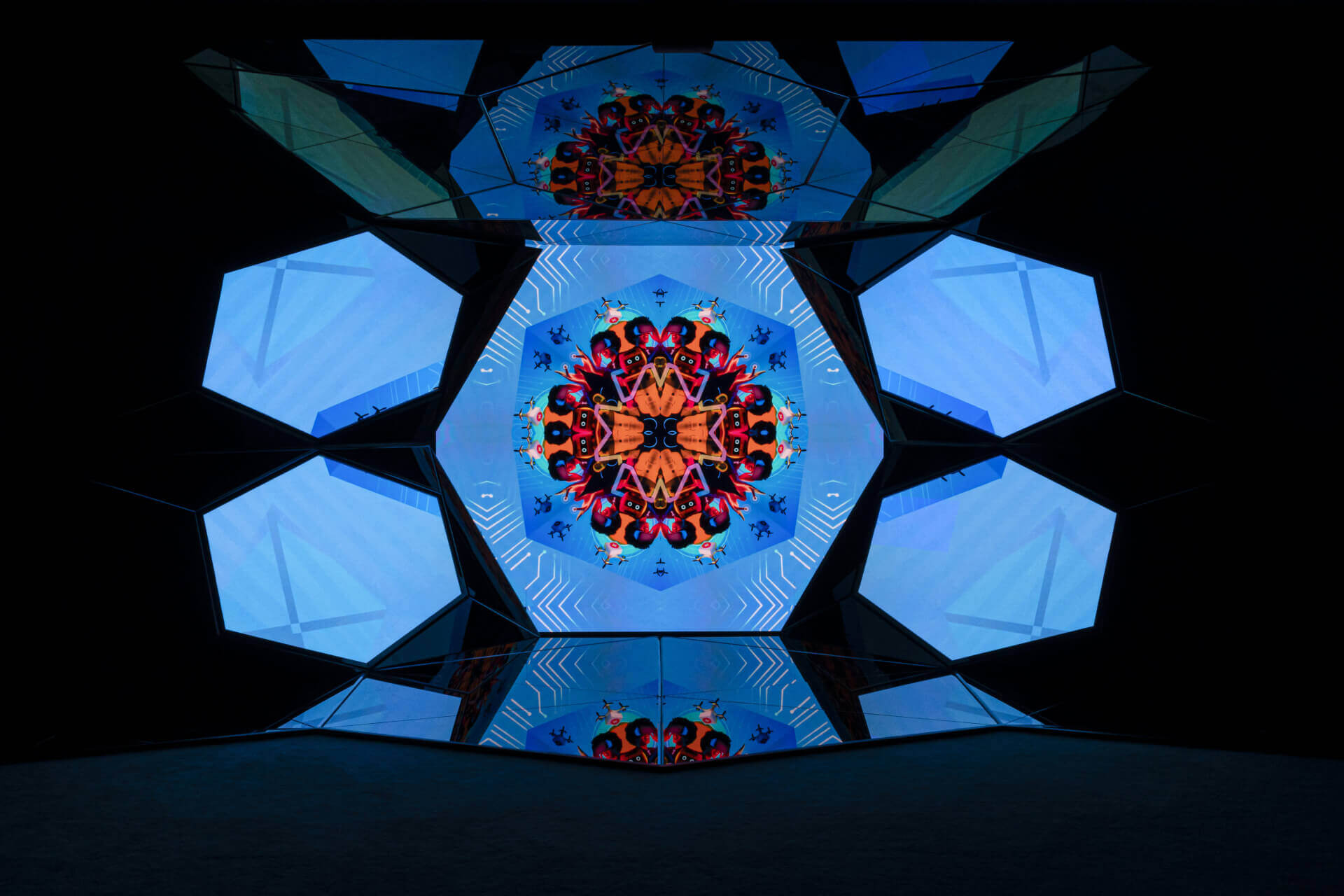
What Manipal's experience center reveals about how institutions are learning to design belief.
Walk into Destination Manipal in Jaipur and something unusual happens. You don't receive a brochure. No one hands you a fact sheet listing rankings, research output, or faculty credentials. Instead, you are moved through a sequence of spaces. Each one calibrated to shift your emotional register, to pull you from curiosity toward conviction. By the time you leave, the decision you came to research has somehow already been made. You feel it before you can explain it.
This is not by accident. It is by design.
The Shift from Information to Experience
Somewhere in the last decade, the world's most sophisticated institutions quietly stopped explaining themselves and started staging themselves. Apple did it first turning retail into theater. Then came car showrooms that felt like galleries, hospital lobbies that felt like hotels, and corporate headquarters whose visitor centers could pass for national museums. The logic was always the same: in a world saturated with information, comprehension alone no longer moves people. Something more visceral was required.
Higher education arrived late to this realization, burdened as it is by tradition and a certain institutional pride in the gravity of the printed word. But arrive, it has. Universities around the world (scrambling to differentiate in a globalizing, digitizing market) have begun to understand what luxury brands have known for decades: experience is not a supplement to communication. It is the communication. The medium is, in the most literal sense, the message.
The emergence of dedicated experience centers on university campuses is one of the quieter but more consequential design stories of our era. And few cases make the argument as clearly as the one unfolding in Jaipur, India, at Manipal University.
Why Universities, Why Now
The context matters. Indian higher education is, by any measure, one of the most competitive landscapes on earth. Thousands of universities compete for a shrinking pool of the most ambitious domestic applicants while simultaneously reaching for global recognition. The traditional tools of differentiation; rankings, placement statistics, faculty lists have become a commodity. Every institution publishes them. Few students read them carefully. Fewer still are moved by them.
At the same time, the prospective student has changed. Today's eighteen-year-old has been raised on interfaces designed by the world's most sophisticated product teams. They've grown up in a world where Netflix engineers the precise sequence in which they discover new shows, where Instagram architects the exact rhythm of their emotional stimulation, where every commercial interaction has been refined to minimize friction and maximize feeling. Then they visit a university and are handed a PDF.
The mismatch is not merely aesthetic. It is strategic. An institution that communicates in formats calibrated for a previous generation is not just old-fashioned. It is, in the most practical sense, unconvincing.
The Problem of Scale
Universities present a particular challenge that most other institutions do not. A consumer brand can be distilled to a single value proposition. A product can speak for itself. A university cannot. It is, simultaneously, a century of history, a philosophy of learning, dozens of departments, thousands of students, hundreds of research partnerships, an alumni network, a set of values, a vision for the future, and a very specific argument about what kind of person you will become by spending four years within its walls.
Linear communication, the brochure, the website, the campus tour led by a nervous sophomore, cannot hold all of this without collapsing under its own weight. The sheer volume of information produces the opposite of conviction. It produces overwhelm.
This is the problem that experience centers are, at their best, designed to solve. Not by presenting everything, but by finding the through-line the single emotional argument that gives everything else its meaning. The center is not a display. It is a translation. It takes the sprawl of institutional complexity and renders it legible, believable, and crucially felt.
Manipal as a Case in Translation
Manipal University Jaipur sits within one of India's most storied educational conglomerates, the Manipal Education and Medical Group, whose origins trace back to a single physician-educator driven by the conviction that ignorance and illness were two sides of the same social wound. From that founding impulse grew a network of institutions spanning medicine, engineering, the humanities, and the sciences. A campus ecosystem so vast and varied that communicating it whole has always presented a nearly impossible editorial challenge.
When we (EuMo), a Mumbai-based experience design firm, were engaged to create what would become Destination Manipal Jaipur, the central problem was precisely this one. The university had a rich story of legacy, global partnerships, vibrant student life, and serious academic ambition. The risk, as we identified it, was fragmentation: presenting these elements as isolated exhibits would reduce the experience to what one of their designers called "a brochure in physical form."
The insight that unlocked the design was deceptively simple. Students, we observed, do not choose universities by assessing their components. They choose universities by feeling a sense of belonging, belief, and aspiration. The question was not how to display Manipal's attributes but how to make a visitor feel those three things within the span of a single visit.
Everything followed from that.
The Five Elements of a World-Class Experience Center
Intent. The first thing a well-designed experience center communicates is that someone thought very hard about you, the visitor, before you arrived. Clarity of purpose is not a soft concept; it is structural. The Manipal center was not designed to impress in the abstract. It was designed to move a specific person, a prospective student, accompanied perhaps by an anxious parent, from uncertainty to confidence. Every subsequent decision in the design was tested against that singular aim. What serves it? What dilutes it?
Sequence. In a museum, you can wander. In a well-designed experience center, you cannot or rather, the wandering is itself orchestrated. The order in which you encounter information shapes what you believe about it. A legacy section that precedes an innovation section produces a feeling of continuity. The same sections in reverse produce something closer to nostalgia dressed up as progress. Our approach to the Manipal center involved deliberate spatial sequencing; each room calibrated to build on the emotional and informational foundation of the one before it, so that by the final space, the visitor arrives at conviction rather than confusion.
Narrative. A narrative is not a list of facts with transition words between them. It is an argument with a protagonist, a tension and a resolution. The narrative at the center of the Manipal experience is not, at its core, about the university at all. It is about the visitor, specifically about the kind of person they might become. The institution's history, its global connections, its academic rigor: all of these become evidence in service of that central claim. When the narrative is built correctly, the visitor feels seen.
Medium. The great temptation in any experience center project and the most common mistake is to let technology become the spectacle. Projection mapping, interactive walls, augmented reality overlays: these are seductive precisely because they are impressive. But impressiveness and meaning are not the same thing. At Destination Manipal, immersive audiovisual environments were deployed not to dazzle but to deepen, to make legible, through sensation, what language alone cannot convey. The technology disappears into the experience. That disappearance is the measure of its success.
Human Interface. Even the most sophisticated physical environment requires interpretation. The hosts stationed within an experience center are the final and most powerful layer of the design. They provide context, answer questions,and, most importantly, modulate the emotional temperature of the space. A well-trained human presence can transform a polished environment into a genuinely intimate encounter. A poorly trained one can undo everything the environment worked to achieve.
The Discipline of Omission
There is a paradox at the heart of any experience design project. The institution almost always wants to say more than the experience can hold. Marketing departments have checklists. Deans want their departments represented. Administrators have favorite statistics. And so the project begins with an act of negotiation which is really an act of editorial discipline about what to leave out.
This discipline of omission may be seen as strategy. Every element that does not serve the central emotional argument dilutes it. A zone dedicated to the university's research output, no matter how impressive the research, will undermine the experience if it disrupts the narrative flow between the legacy section and the student life section. The omission of that zone or its folding into another space is a commitment to the visitors.
The institutions that understand this are rare. Most prefer the comfort of completeness over the power of selection. But the best experience centers in the world in education, in commerce and in culture are almost always defined less by what they include than by what they have had the courage to exclude.
The Illusion of Effortlessness
Walk through Destination Manipal's immersive zones and the experience feels entirely natural. The light sequencing is correct. The sound is orchestrated. The sequence of spaces that move you through it make perfect intuitive sense. Nothing feels designed because everything has been designed. The seamlessness is the product of extraordinary effort concealed.
This concealment is itself a form of respect for the visitor. The moment a design draws attention to itself, the moment you notice the projector, the moment the guided narration feels scripted, the moment the lighting seems too deliberate, the spell breaks. You are returned from participant to observer, from someone being moved to someone watching themselves being moved. The emotional distance that results is fatal to the experience's purpose.
Behind every seamless experience is a hidden infrastructure of decisions: the precise angle of a projection, the programmed rhythm of an interactive sequence, the scripted pauses in a guide's narration, the color temperature of light in a room meant to evoke aspiration. Each element is negligible in isolation. Together, they produce something that feels effortless which is to say, they produce the highest possible achievement in experience design.
Measuring the Immeasurable
Anyone who has tried to justify the budget for an experience center to a finance committee has confronted the fundamental measurement problem: how do you quantify a feeling?
Footfall is the most common metric because it is the easiest to count. But footfall measures exposure, not impact. The metrics that actually matter include a shift in perception, the quality of engagement and influence on the ultimate decision. The most honest practitioners in the field have replaced traditional metrics with a richer set of indicators: session duration, the quality of questions asked afterward, the difference in conversion rates between visitors who did and did not spend time in the center, longitudinal tracking of how admitted students describe their initial attraction to the institution. These are not perfect measures, but what they reveal, consistently, is something that should surprise no one: people who feel something are more likely to act. The experience center's return on investment is, in the end, the return on belief.
Our Role: From Space to System
We, EuMo (Eureka Moment) occupy a unique position in the design landscape. We do not design spaces in the conventional sense, nor do we practice conventional brand strategy. We operate at the intersection of both, which is precisely where experience centers live.
What we brought to Manipal was a framework we call Design Intelligence, a methodology that begins with the strategic question: what does this institution need a visitor to understand, feel, and do? The answer to that question becomes the brief. The spatial design, the content architecture, the audiovisual strategy, the human experience layer: all of it flows from that upstream clarity.
This approach, translating institutional ambition into spatial logic, is repeatable across sectors, and we have deployed versions of it for entities as varied as the Reserve Bank of India's monetary museum, the Tata Institute of Fundamental Research, and the Dubai Expo pavilion for Reliance Industries. In each case, the underlying challenge is identical: a complex institution with a layered story that needs to be made coherent, credible, and emotionally compelling in the time it takes a person to walk through a room.
What Most Get Wrong
Experience centers fail in predictable ways.
The most common failure mode is technology-first thinking (projection mapping, touchscreens, interactive tables) rather than building around a story. The result is a space that impresses briefly and means nothing lastingly. Visitors remember the LED wall. They do not remember why they came.
Close behind it is fragmented storytelling; the experience center built by a committee, in which each department or stakeholder has been given a zone, and those zones exist in peaceful, purposeless coexistence. There is no thread. There is no argument. There is only content, organized spatially, which is not the same thing as an experience.
The third failure is operational: the beautiful opening week followed by gradual decay. Guides stop being trained. The content grows stale while the institution moves on. The physical space remains, but the experience it was designed to produce has quietly expired. An experience center is not an installation. It is a living system, and it requires the same ongoing investment as any other living system.
The Design of Belief
There is something worth pausing on in what all of this represents. Experience centers are, at their most fundamental level, instruments of persuasion. They exist to produce a specific belief in a specific person at a specific moment: this is the right place for me. The design of that belief, the deliberate engineering of a space that makes a human being feel something true is the essence of expert experience direction.
A well-designed experience makes authenticity visible. Manipal University has a real history, a genuine founding philosophy, actual students whose lives were changed by their time within its walls. The experience center translated this with clarity, with editorial discipline, with careful attention to sequence and medium and human presence into something a prospective student standing in Jaipur could actually feel.
That is communication at its highest register.
As higher education grows more competitive and more global, as attention becomes scarcer and expectations rise, the institutions that learn to design belief and to render it visible and tangible, will carry a significant advantage over those that do not. The brochure had its century. The experience center is having its moment.
And the students who walk through Destination Manipal and leave feeling that they have found their place, their future, their people, they are not wrong. They have simply been helped to find, in the space of a half hour, what would otherwise have taken months to understand.
That is what design, at its best, has always done.
EuMo is an integrated brand experience design firm based in Mumbai. Destination Manipal Jaipur was designed in partnership with the Manipal Education and Medical Group.