India's higher education rebranding wave has a missing layer.
In a two-bedroom flat in Indore, a father opens his laptop to a university's admissions film. Drone shots of a glass atrium. A voiceover promising his daughter that along with her education,she'll co-create her future with faculty, industry and technology. He watches it twice. Then he opens a second tab and searches a number he half-remembers from a news segment: the share of Indian graduates considered employable by the companies actually hiring them.
That number is 42.6 percent, according to the Mercer-Mettl Skills Index, down from 44.3 percent the year before. No campaign survives contact with that number on its own. And the honest answer to what happens next in that household is: he closes both tabs, and calls his cousin, whose son graduated from a similar-sounding institution two years earlier, to ask whether any of it was true.
That phone call is the real brief facing Indian higher education right now. -How do we build something a skeptical family can actually verify before, during, and after the campaign has done its job of getting them to look.
The employability number every family already knows
India's Gross Enrolment Ratio in higher education sits near 28 percent, against a National Education Policy target of 50 percent by 2035 meaning the market is expanding fast, into families with less inherited experience of what a "good" private university actually delivers. At the same time, employability has been sliding, not rising, even as more institutions launch. NEP, the National Credit Framework, the Academic Bank of Credits 2020's reforms are a serious attempt to close that gap at the policy level. But policy language has a way of becoming brand language, and almost every private university now describes itself as skill-integrated, industry-aligned, outcome-based, future-ready. When every prospectus reads like the same circular, the words stop doing the work of choosing.
This is the sameness trap: a category where everyone is saying the right thing, which means saying it distinctively is the only lever left. And distinctiveness, done as a logo and a film, still stops one layer short of what an Indian household is actually deciding.
Why a campaign alone can't close a household's trust gap
Unlike Western markets, where the applicant is close to the sole decision-maker, Indian enrollment is a household decision, often multi-generational, often first-generation-into-private-higher-education. A single brand narrative has to close two different trust gaps simultaneously: the student's want for identity, agency and a future on their own terms, and the parent's need for safety, placement data, faculty credibility, a name that survives scrutiny from relatives. A campaign built only for the emotional register of the applicant is, doing half the job in the room where the decision actually gets made.
This is where most rebrand engagements run out of runway. They deliver a strategy deck and an identity system and leave the institution to translate that promise into the hundred small moments, the admissions office, the campus tour, the faculty interaction, the hostel visit, where a parent decides whether to believe it.
Brand strategy without a plan for behaviour, space and delivery is a message with nowhere to land.
Design Intelligence: the layer that's missing
EuMo's approach to this problem is built around a four-part framework it calls Design Intelligence, and it maps almost exactly onto where Indian university rebranding keeps stalling:
01 — The Brand, built on strategic brand thinking: what the institution stands for, and why that's true and ownable rather than borrowed NEP vocabulary everyone else is also using.
02 — Behaviour, using behavioural science insight: how staff, faculty and students actually need to act for the brand promise to be credible day to day.
03 — The Experience, shaping how people see, move and interact: the physical and digital environments, campuses, admissions journeys, wayfinding, service moments where the brand promise is tested in real time by a skeptical visitor.
04 — The System, activating platforms, content and technology at scale: the infrastructure that lets a brand promise hold together as an institution expands to new schools, campuses, or geographies, without diluting into the same generic language as everyone else.
Most rebranding engagements in Indian higher education stop at layer one. The institutions that actually close the trust gap are the ones treating all four as a single, sequential design problem because a family isn't evaluating a logo. They're evaluating whether the story in the film matches the room they're standing in six weeks later.
Case study: Atlas SkillTech University, as a structural problem
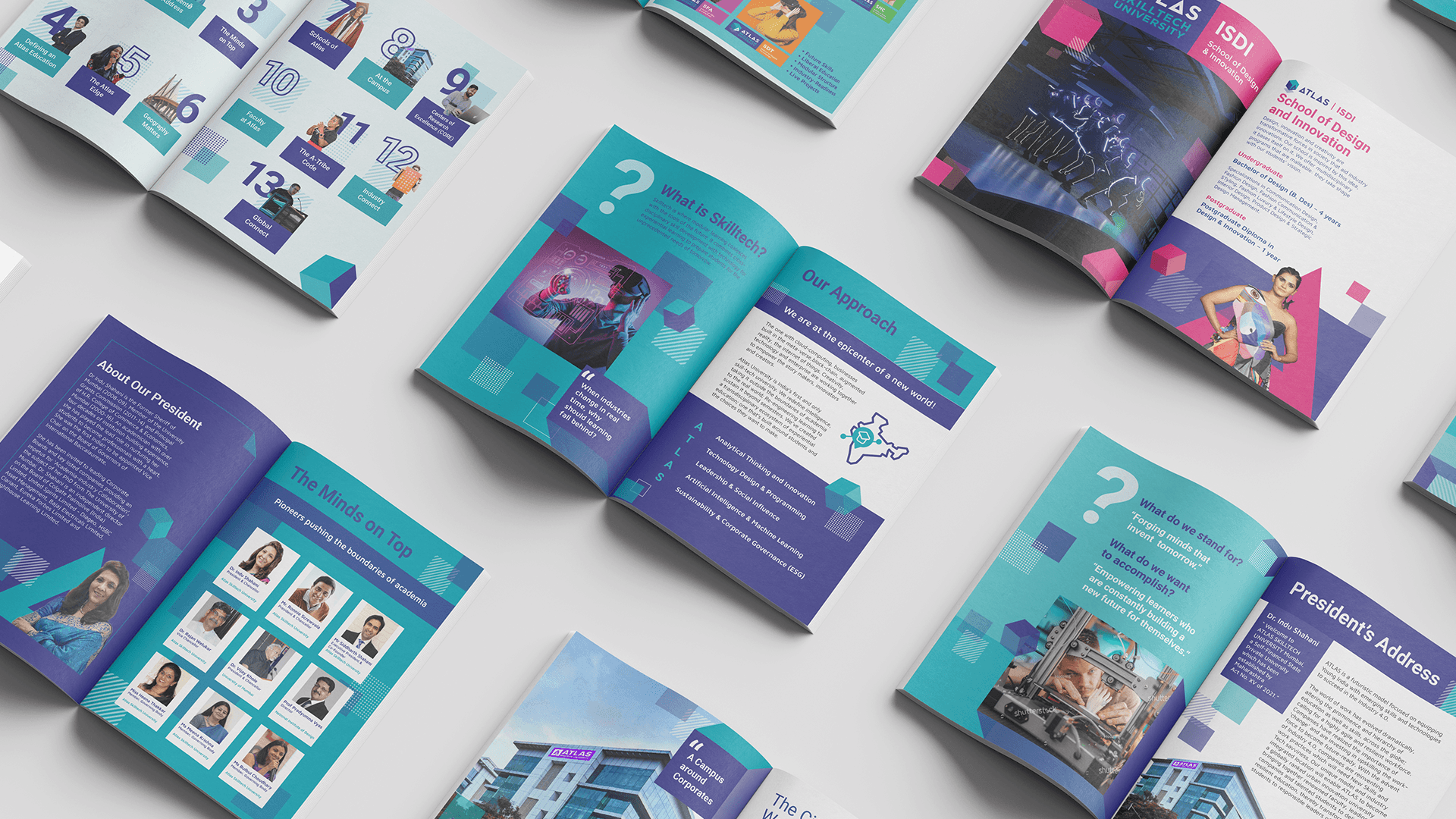
Atlas SkillTech University is a useful test of this, precisely because it launched with real structural exposure: five founding schools and sixteen programmes at inception, built on the equity of ISDI Parsons, with a brand positioned around students co-creating their futures alongside faculty, industry and technology rather than simply receiving instruction.
A launch at that scale has a genuine behavioural and structural problem before it has an outcomes problem: how does a fragmented, fast-growing institution hold together in the mind of an information-rich, skeptical household, before placement data exists to do the convincing on its own? EuMo's brand architecture for Atlas, a disciplined umbrella system unifying multiple schools under one entrepreneurial, forward-looking identity functioned as exactly that: connective tissue holding a five-school launch together as one coherent, ownable idea rather than five unproven bets asking for trust separately.
The brand for Atlas Skill tech won the REBRAND100 Global Award.
That's layer one and two of Design Intelligence doing real structural work, not decorative work. The next test for any institution built this way (Atlas included) is whether layers three and four, the spatial experience and the scaled system, are carrying the same promise as consistently as the identity does.
The layer most rebrands skip entirely
This is where most Indian university branding stops short, and where the real differentiation now sits. A brand doesn't just live in an admissions film. It lives in the moment a family walks through the gate, the campus tour, the wayfinding, the open house, the physical space where the promise in the film either holds up or falls apart in front of them.
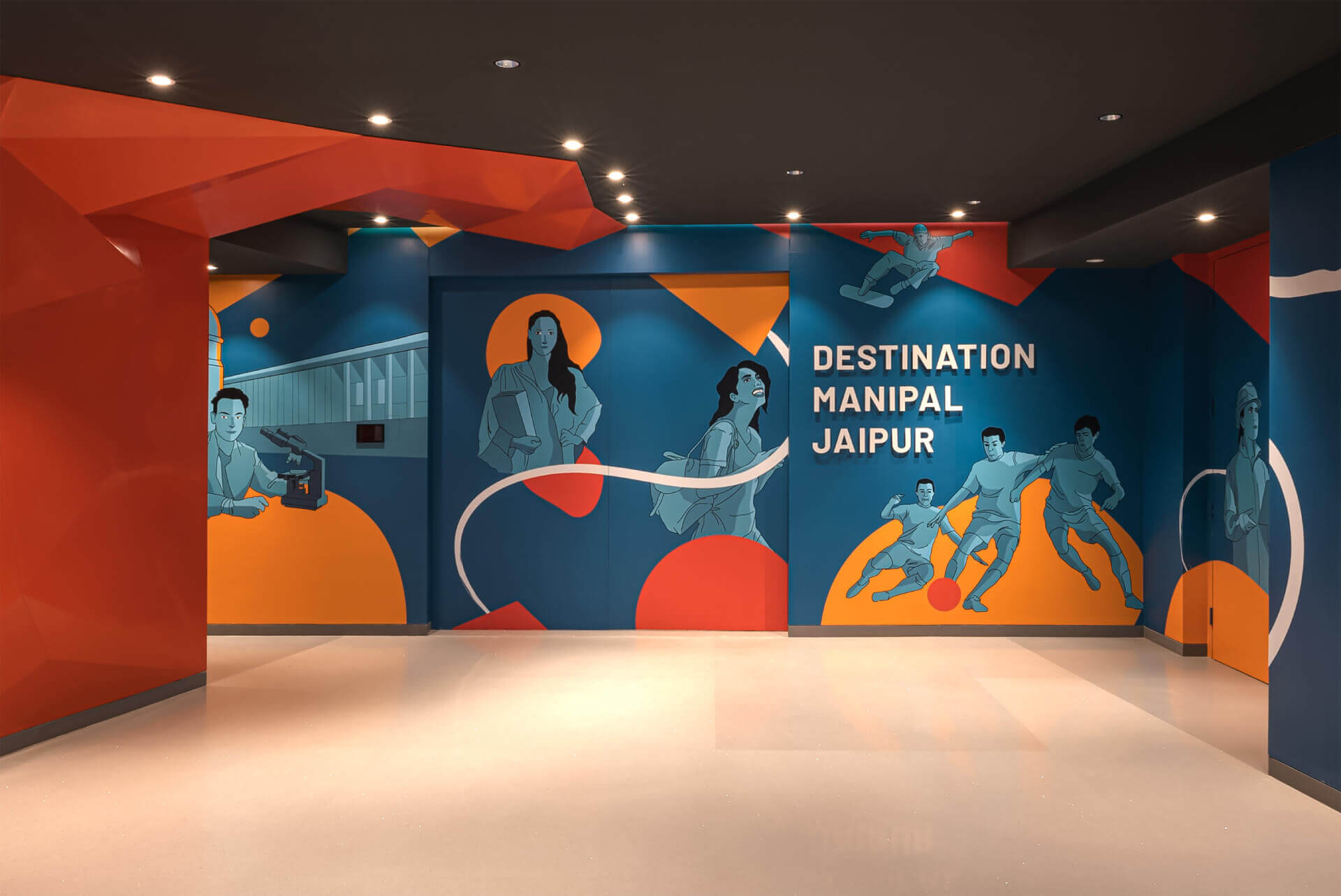
EuMo's spatial and experience-centre practice including Destination Manipal's experience centres in Udupi and Jaipur is built specifically for this layer: designing the physical trust moment itself, not just the message that gets a family curious enough to visit. This is Visitor Experience (VX) as a discipline, and it's the one most university brand engagements in India skip entirely, treating spatial design as an afterthought to the campaign rather than as the place where the campaign's claims are actually adjudicated.
One system, not four vendors
The reason this matters structurally, not just aesthetically, is that Brand, Customer, Employee and Visitor Experience are not four separate services for an institution like a university they're four faces of the same decision a family is making. The brand promise (BX) is only as credible as the family's actual admissions journey (CX), which is only as credible as the faculty and staff living the promise daily (EX), which is only as credible as the physical campus a visiting parent walks through and judges in real time (VX). Institutions that hire four different vendors for these four layers tend to produce exactly the incoherence the article's opening scene describes, a beautiful film and an unverifiable claim. Institutions that design all four as one system, through one integrated intelligence, are the ones a skeptical household actually ends up trusting.
EuMo's education-sector work beyond Atlas including brand strategy for Adani International School, Oaktree International School and Dirubhai Ambani School, alongside its ongoing spatial practice at Destination Manipal reflects this as a sector practice, not a single case study built around one client.
What the next wave of Indian university brands needs to get right
More institutions are launching under NEP's push toward expansion, and foreign universities are beginning to open campuses inside India rather than simply recruiting Indian students abroad, raising the competitive floor considerably. In that environment, the institutions that win the next decade won't be the ones with the sharpest film or the most on-trend vocabulary. They'll be the ones whose brand, behaviour, spatial experience and scaled system were designed together from day one, by people thinking about all four at once, so that by the time a family is standing in the admissions office, checking the promise in the film against the room in front of them, there's nothing left to catch.
The father in Indore, again
He closes both tabs eventually, makes the call to his cousin, and a few weeks later, visits the campus himself. What changes his mind isn't a better version of the film he already watched twice. It's whether the space he's standing in, the people he meets, and the answers he gets feel like a continuation of that promise rather than a performance of it. That continuity between what an institution says and what a family can verify with their own eyes is what Design Intelligence is built to deliver, and it's the layer India's higher education rebranding wave still largely leaves out.