Walk into most corporate offices today and you will encounter a peculiar paradox.
The walls are painted in brand colors. The logo gleams from the reception desk. Framed values, integrity, innovation, people-first, gaze down from every corridor. And yet, somehow, the place feels like it belongs to no one in particular. It could be any company. In any city. On any floor of any tower in any business district on earth.
While it looks like an aesthetic failure, it is a strategic one. And as artificial intelligence accelerates, as hybrid work reshapes how often employees actually show up, the cost of that failure is quietly becoming enormous.
The office, for most of the twentieth century, was simply where work happened. Its cultural function was incidental. Employees absorbed organisational values the way children absorb family values: through proximity, observation, repetition, and the daily friction of being around others who embodied those values. The office did not need to teach culture deliberately. Osmosis did the work.
That era is over. And most organisations have not yet reckoned with what comes next.
“The office is no longer competing with other offices. It is competing with the convenience of everywhere else.”
The Office Has an Identity Crisis
The return-to-office debate has consumed boardrooms and op-ed pages in roughly equal measure since 2021. Executives have mandated, employees have resisted, compromises have been struck, and the arguments have grown circular. What has received far less attention is the more fundamental question lurking beneath the attendance debate: even when people do come in, what are they coming in for?
The traditional answers such as access to equipment, proximity to colleagues, oversight by managers, have eroded. Knowledge work has become, to a striking degree, location-independent. A software engineer in Bengaluru can collaborate in real time with a product manager in London and a designer in São Paulo, without any of them needing to be anywhere specific. Artificial intelligence is accelerating this decoupling further: tools that draft, summarize, analyze and communicate are reducing the number of tasks that require human-to-human interaction at all.
And yet organisations continue to invest billions in physical workplaces. CBRE estimates global corporate real estate spend in the hundreds of billions annually. Organizations have not abandoned the office. They have simply not figured out what it is for anymore.
The organisations that are figuring it out are the ones - shifting from thinking about the office as a place of work to thinking about it as a place of connection. The distinction sounds soft. Its implications are anything but soft.
The Hidden Function of the Workplace
Ask employees what they miss most when working remotely and you will rarely hear "access to the printer" or "the ergonomic chair." You will hear about people. The spontaneous conversation that became a breakthrough idea. The lunch that became a friendship. The moment of watching a senior colleague handle a difficult situation and learning, silently, how it was done.
Organisational researchers have long understood that workplaces function as community infrastructure. They are where social identity forms, where trust is built through repeated low-stakes interaction, where employees locate themselves within something larger than their individual job descriptions. People may work for companies, but they stay and more importantly, they commit because they feel part of something that has meaning beyond their compensation package.
This is not a soft observation. It is among the most robust findings in organisational behavior. Belonging, psychological safety and social cohesion are not pleasant-to-have features of organisational life. They are determinants of performance, innovation, retention and resilience. McKinsey's research on organisational health has consistently found that the companies in the top quartile on culture metrics deliver dramatically superior shareholder returns over time.
The problem is that belonging is not something that can be manufactured through a company all-hands meeting or a Slack channel named "random." It accumulates through thousands of small, unremarkable interactions, over time, in physical proximity. It requires a place. And the place, increasingly, needs to be designed for it.
“People may work for companies, but they stay because they feel part of something larger than themselves.”
Why Culture Is Harder to Transmit Than Ever Before
For most of organisational history, culture was transmitted through apprenticeship. Junior employees watched senior ones. They absorbed not just technical skills but judgment, tone, values and institutional memory. They learned how decisions were actually made as distinct from how the org chart suggested they were made. They developed what the sociologist Michael Polanyi called tacit knowledge: the things that cannot be written down precisely because they are too contextual, too relational, too embedded in lived experience to be captured in a policy document.
Hybrid work has severely disrupted this transmission mechanism. When a junior analyst works from home three days a week and comes in on the days her manager is remote, the apprenticeship model degrades. When a new hire's primary exposure to company culture is a two-day onboarding program and a Confluence wiki, something is lost that a well-worded mission statement cannot recover.
Artificial intelligence is adding a new layer of disruption. As AI tools take on more of the transactional, analytical and communicative labor that once required human coordination, the organic moments of human connection that produced cultural transmission are further reduced. Employees who once collaborated through shared tasks are increasingly working in parallel with AI intermediaries. The touchpoints are fewer. The opportunities for cultural osmosis are contracting.
The challenge facing organisational leaders is not productivity, AI may be helping with that. It is cultural continuity. How do you sustain a coherent organisational identity when the mechanisms that historically sustained it are atrophying? The answer, for a growing number of forward-thinking organisations, involves a serious rethink of what the physical workplace is actually for.
Experience Environments
Here is a reliable test of organisational authenticity. Ask a company's employees what its values are. Then observe the physical environment in which those employees work.
If the stated values include collaboration but the office consists of rows of individual workstations with no shared space, employees will notice the contradiction. If the stated values include inclusion but the building has no prayer room, limited accessibility provisionss and a nursing room that requires a special key request, employees will draw the obvious conclusion. If the stated values include psychological safety but the floor plan places executives behind glass offices that overlook the open plan visible, watchful, architecturally superior, the spatial hierarchy will communicate the actual organisational values more powerfully than any all-hands speech.
Architecture is not politically neutral. Space communicates hierarchy, priority, and belonging with a directness that language cannot match. A shared kitchen that senior leaders actually use is a statement. An executive floor that junior employees never access is also a statement. The question is not whether your office is communicating organisational values. It always is. The question is whether it is communicating the ones you intend.
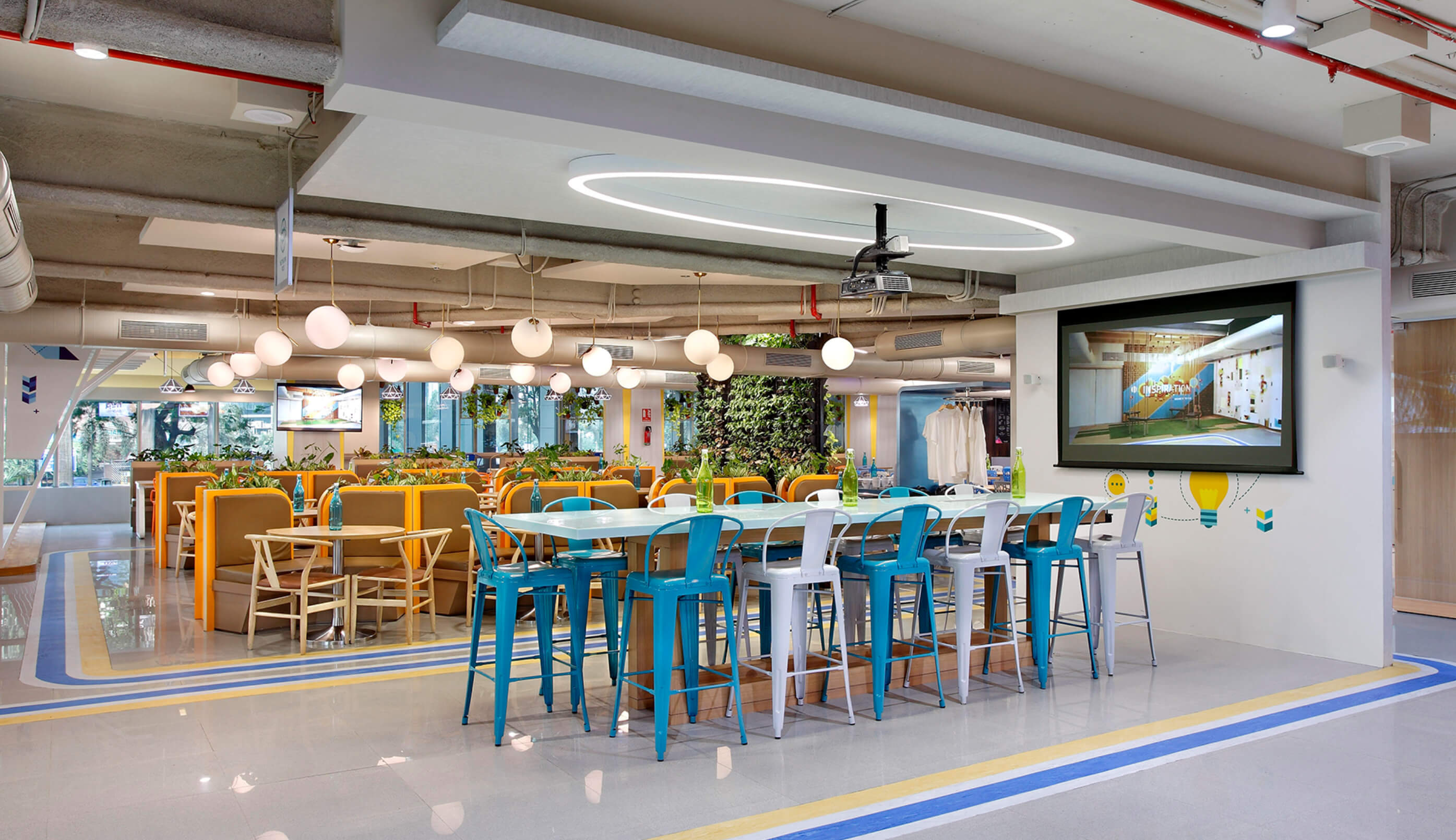
The organisations getting this right are making deliberate choices. Open collaboration zones signal that ideas can come from anywhere. Wellness and focus spaces signal that the organisation respects the full human needs of its employees, not merely their productive output. Co-designed spaces where employees have been involved in shaping their environment signal that voice and agency are genuine values, not rhetorical ones. Inclusive facilities signal that belonging is not conditional on majority-group membership.
Each of these design choices is, in the deepest sense, a values statement. And unlike mission statements, they are experienced bodily, daily, without requiring the employee to read anything.
“Employees trust what organisations build more than what they say.”
Introducing Brand Enculturation
There is a concept emerging among a small number of organisational designers, workplace strategists and culture practitioners that deserves wider attention. It might be called Brand Enculturation: the deliberate design of the physical workplace as a mechanism for transmitting organisational culture.
It is worth distinguishing this from two adjacent concepts that are sometimes confused with it. Employer branding is primarily an external exercise, the way an organisation presents itself to prospective talent. It is recruitment marketing. Brand Enculturation is internal and experiential: it is what happens to existing employees, every day, in the physical environment where they work.
Office branding like logos on the wall, brand-colored furniture, reception desk aesthetics is superficial by comparison. It is the visual vocabulary of a brand applied to a space, without necessarily engaging with the deeper question of what the space is communicating about how people should relate to each other, what behaviors are valued, what the organisation actually believes.
Brand Enculturation operates at a different level. It asks: what does it feel like to be in this organisation? And then it attempts to make the physical environment answer that question honestly, consistently, and memorably. It treats the workplace not as a container for work but as a medium for culture. Not a stage set, but a living expression of organisational purpose.
The strongest cultures are not communicated, but experienced. And the experience, increasingly, begins with the physical environment.
Lessons from organisations That Design for Belonging
Across India and globally, a number of organisations are beginning to understand and act on these principles, though they rarely use the vocabulary of Brand Enculturation explicitly.
The Global Capability Centres proliferating in Hyderabad, Bengaluru, and Pune represent one of the most interesting laboratory environments for workplace design in the world. These campuses, which house the India operations of multinational companies ranging from financial institutions to technology firms are attempting something genuinely difficult: creating spaces that feel locally authentic while connecting employees to a parent-company culture headquartered half a world away. The most sophisticated GCC operators have moved well beyond copying their headquarters aesthetic and are investing in culturally resonant, locally designed spaces that nonetheless carry the values of the parent brand.
Indian conglomerates like Piramal have invested significantly in campuses that attempt to express family culture, long-termism, and institutional identity through spatial choices. Technology companies like BrowserStack, built from their earliest days as remote-first, have approached their physical spaces with unusual intentionality, precisely because they cannot rely on physical presence as a default cultural transmission mechanism. Every square foot carries more weight.
The principles that emerge from these examples converge on a few key insights.
Design Features | What they look like | What they signal |
Activity-based environments | spaces designed for different modes of work rather than for individual ownership of desks | signal that the organisation values outcome over presence |
Human-centered Design | spaces that begin with employee experience rather than square-footage optimization | signals that people are the organisation's primary asset, not its real estate portfolio. |
Employee co-creation | involving staff in the design and curation of their own environments | signals that voice is a real organisational value |
Spatial storytelling deserves particular mention. The most sophisticated organisations are using the physical environment to narrate their history, values, and aspirations: through curated artifacts, local cultural references, employee-generated content embedded in the space, and environmental design choices that accumulate into a coherent organisational identity. The office becomes, in effect, a museum of what this organisation believes and where it is going.
The most effective workplaces are not designed around desks. They are designed around human needs.
The Office as a Service
The metrics by which most organisations evaluate their real estate are lagging indicators of an outdated model. Occupancy rates tell you how many people came in. Utilization data tells you how many seats were used. Neither tells you what the experience of being in that space did to the people who passed through it.
The more useful question, which is harder to measure but far more consequential is: did employees leave this space feeling more connected to this organisation than when they arrived? Did the environment reinforce the cultural identity they are being asked to carry and transmit? Did it give them something to tell a new colleague, a sense of pride, a feeling of belonging to something worth belonging to?
Some might consider these questions soft but they are directly connected to retention, engagement, and the discretionary effort that distinguishes high-performing organisations from merely adequate ones.
Gallup's long-running research on employee engagement consistently finds that employees who feel they belong contribute more, leave less frequently and perform better. The physical environment is not the only input to belonging, but for the days when employees are physically present, it is among the most powerful ones.
The future of workplace strategy, for the organisations willing to think seriously about it, involves treating the office not as a fixed asset to be managed but as a service to be continuously refined in response to employee experience. Like any good service, it should be designed around the needs of its users, measured by their outcomes and iterated when it falls short. The question is not how many people used the space this week. The question is how those people felt about their work, their colleagues, and their organisation after using it.
The Last Physical Advantage
Artificial intelligence will automate tasks. Digital platforms will distribute work across time zones and organisational boundaries. Information will become abundant to the point of meaninglessness. The knowledge economy's traditional scarcities like access to data, access to expertise, access to processing capacity are dissolving.
What becomes scarce, in that world, is not intelligence. It is belonging. Identity. Shared purpose. The sense of being part of something that has stakes beyond your individual contribution.
These are not things that AI can generate, or that digital platforms can fully replicate, or that a well-crafted all-hands message can reliably sustain. They require human beings in proximity with one another, over time, in environments designed to facilitate the accumulation of trust and the transmission of culture.
The organisations that win the post-AI era may be those that are most deliberately, most thoughtfully, most honestly intentional about creating places where people feel they belong.
The office, stripped of its traditional justifications, stands at a crossroads. It can become a formal obligation, a place people come to because they are required to or it can become something rare and valuable: a physical embodiment of what an organisation actually believes, and a mechanism for transmitting that belief to the human beings who carry it forward.
Most organisations are choosing, by default, the former. The opportunity and the competitive advantage lies in choosing the latter.